You'll hear a lot of people call healthcare real estate "recession-proof."
I don't use that phrase, because it isn't true. Nothing is recession-proof.
The better question is this: when the economy slows down, does the tenant keep paying rent? That's a different question than whether the practice has a good year.
First, the honest part
Dental care does dip in a recession.
A study in the Journal of the American Dental Association looked at the Great Recession. The share of people visiting a general dentist declined slowly and steadily, hitting a low in 2010. Orthodontic visits, which are more optional, fell even further before recovering.
COVID was worse in the short run. In March 2020, the American Dental Association recommended that dentists postpone all but urgent and emergency care, and most offices paused routine visits for several weeks.
So if someone tells you dental demand never drops, they're selling you something.
What the spending data shows
That said, the dips have been small. Here's total U.S. dental spending since 2000, adjusted for inflation, based on ADA Health Policy Institute data:
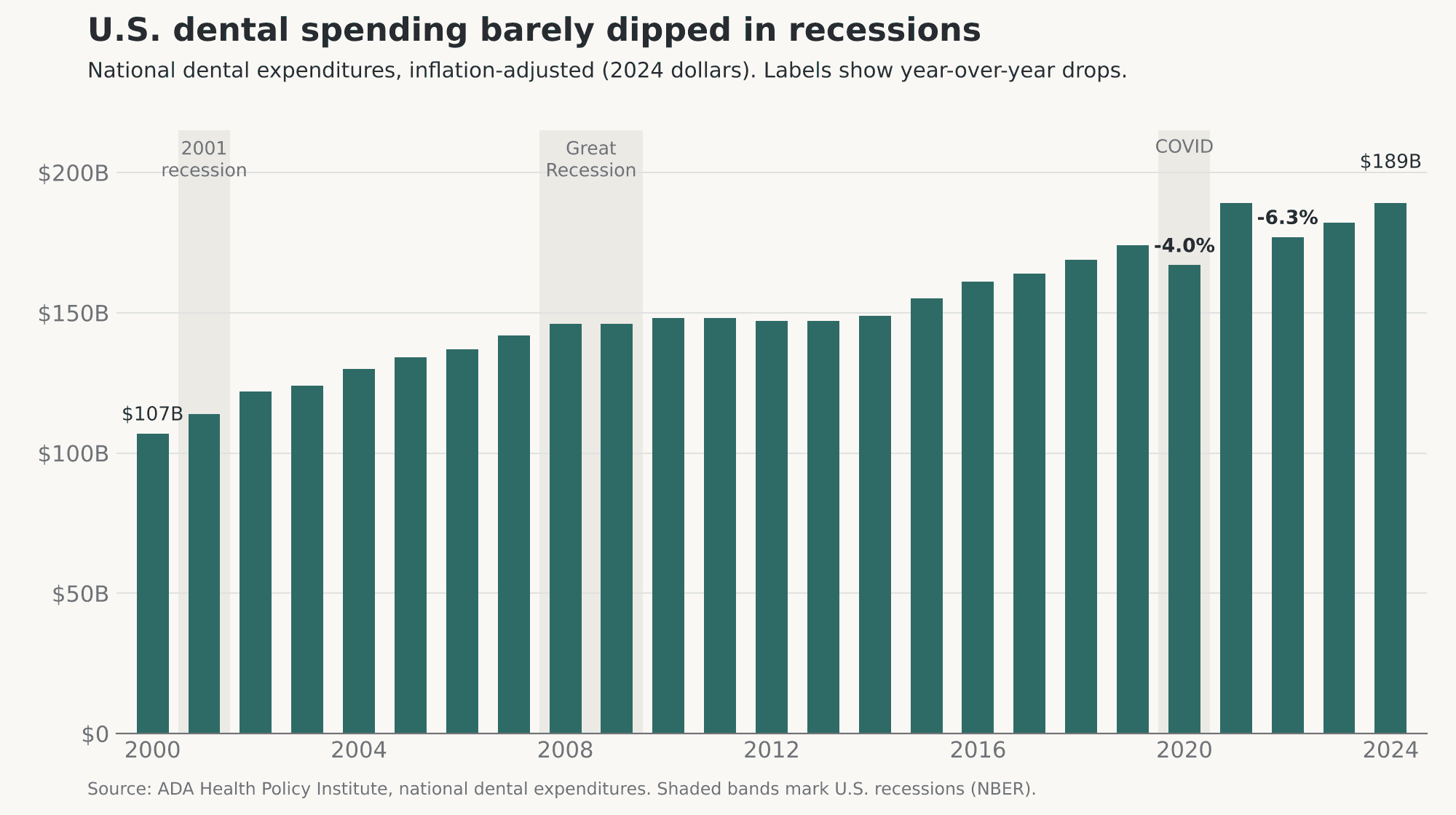
During the Great Recession, inflation-adjusted dental spending went flat. Its worst year was a 0.7% slip in 2012. In 2020, with offices closed for weeks, it fell 4%, then hit a new high the next year.
The biggest drop came in 2022, at 6.3%. That wasn't a recession. The post-COVID catch-up in appointments wore off, and high inflation shrank the real value of what people spent.
Now compare that to what happened to real estate prices in recent downturns:
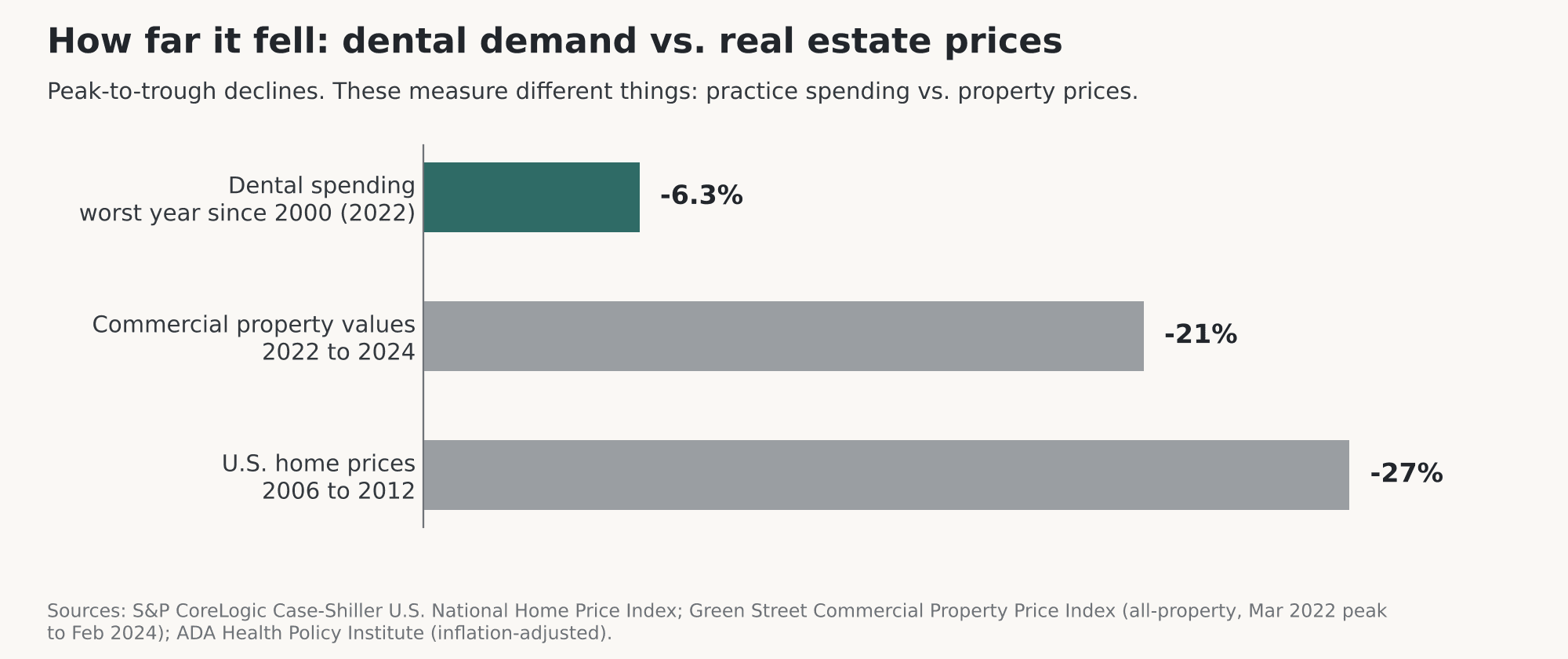
These aren't the same measurement. One is how much people spend at the dentist, and the others are what properties sell for. But the comparison shows where the swings tend to come from. Demand for the tenant's services held up. Building prices moved with interest rates and credit.
A note on the middle bar: the commercial property figure covers all commercial property, not office alone.
Now, the landlord's view
Here's what matters to the building owner. A practice doesn't need a great year to pay rent. It just needs to stay in business.
That's why one of the first things experienced medical landlords check is rent as a share of the tenant's revenue.
Say a dental practice brings in $1,200,000 a year and pays $84,000 in rent. Rent is 7% of revenue.
Now a recession hits and revenue drops 20%, to $960,000. Rent is still $84,000, which is now 8.75% of revenue.
That hurts the practice's profits. But it's nowhere near the point where rent goes unpaid. The practice would cut costs elsewhere long before it walked away from a building it spent hundreds of thousands of dollars to build out.
Compare that to an apartment, where a tenant who loses their job may stop paying next month.
Why the lease structure helps
Three features of a typical medical office deal help in a downturn.
Long leases don't reset. Apartment leases usually renew every 12 months. In a recession, rents can drop at renewal and vacancies rise. A medical lease with 7 years left keeps the same rent, plus whatever annual increase is written into it. For more on how apartments behave, see How Multifamily Real Estate Performs During a Recession.
Triple net leases protect your expenses. If property taxes or insurance rise during a rough patch, the tenant pays them, not you. See What Is a Triple Net Lease?
Tenants can't easily leave. Moving a dental or medical practice means rebuilding plumbing, imaging rooms, and equipment hookups. Practices rarely do that to save on rent.
What actually hurts medical office in a downturn
If a recession doesn't usually stop rent checks, what does cause damage? From what I've seen, these are the real risks.
1. Too much debt on the building.
This is the big one. In 2022 and 2023, plenty of real estate with on-time rent still got into trouble because of floating-rate loans. Payments jumped, and owners were forced to sell or issue capital calls. That's why I favor deals with conservative leverage and fixed-rate debt.
2. Values fall even when rent doesn't.
When interest rates rise, buyers demand higher cap rates (yields), which pushes prices down. Medical office values dipped in 2022 and 2023 even though most tenants kept paying. RevistaMed reports that the average cap rate on medical office building sales rose to 7% in the fourth quarter of 2023, up 90 basis points from a year earlier. If you don't have to sell during that window, it mostly doesn't matter. If you do, it matters a lot.
3. A weak tenant or guarantor.
Many practices are now owned by private-equity-backed groups. Some of those groups carry heavy debt. In a downturn, a struggling parent company is a bigger risk than a slow quarter at one office.
4. All your eggs in one building.
A single-tenant building is either fully leased or empty. Spreading capital across many buildings and tenants smooths that out.
The demand picture going in
Recessions hurt less when you start in a strong position. According to JLL's 2026 Medical Outpatient Building Perspective, occupancy in medical outpatient buildings is at a record 92.7%, and new construction is running at about 1% of inventory.
When supply is tight, a tenant that does leave is easier to replace.
A downturn checklist for medical office deals
Before investing, I'd want clear answers to these:
What is rent as a share of each tenant's revenue?
Who guarantees the leases, and how healthy are they?
How many years are left on the leases, on average?
Is the debt fixed or floating? When does it mature?
How much leverage is on the portfolio?
How many buildings and tenants share the risk?
What happens to returns if one or two buildings go vacant?
A good sponsor will have these numbers ready. If they don't, that tells you something. Here's how I vet sponsors.
The bottom line
Medical office isn't recession-proof. Patients delay care when money is tight, and practices feel it.
But a practice having a weaker year and a practice not paying rent are two very different things. With rent at a small share of revenue, long leases, and conservative debt, medical office has historically been one of the steadier places to own real estate through a downturn.
The building is rarely the weak link. More often it's the debt.
Join the Vestus network for new posts, deal announcements, and tax strategies for high-income professionals.
I am happy to answer questions about how any of this works, whether or not you ever invest with us.